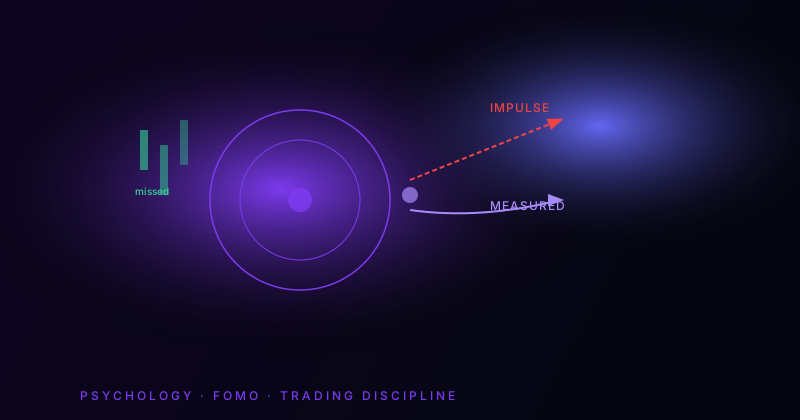
You've watched a trade. It was in your watchlist. You hesitated. It moved 3% in 15 minutes.
Now you have two options: move on, or chase it.
Most traders chase. Most traders lose money doing it.
FOMO — Fear of Missing Out — is the second most destructive psychological pattern in trading, after revenge trading. And unlike revenge trading (which usually happens after a loss), FOMO strikes when everything is going well for other people. Which makes it harder to see coming.
What Actually Happens When You Chase
When you see a large move that you missed, your brain does something specific: it anchors to the entry you should have taken and compares everything to that point. The move from ₹150 to ₹185 feels like a guaranteed continuing move.
But the market doesn't know where your hypothetical entry was.
When you enter a move that's already 3% extended:
- The easy money in the move is already done
- Whoever entered earlier is now looking to exit (into your buy order)
- Your stop-loss, if placed correctly, is now far away — meaning your R:R is terrible
- The slightest pullback will trigger your stop, often before the move continues
You're not entering a trade. You're becoming the exit liquidity for people who were smarter or faster than you.
The Three Types of FOMO Trades
1. Chase after a clean breakout you hesitated on
You saw the setup, waited for "confirmation," and then entered 50 points above your original trigger. The move was real, but your timing destroyed the edge.
2. Random entry on social media momentum
Someone in a Telegram group says "BNF flying, 🚀🚀🚀". You open the charts, see it's already up 400 points, and feel the urge to get in. You don't even have a clear stop in mind.
3. Recovery FOMO after a loss
You took a loss on your planned trade. Now you see another stock moving and feel like you "need" to make it back. This is revenge trading disguised as FOMO.
Why FOMO Is Especially Dangerous in F&O
In equity, chasing a stock that's run 5% means you're buying at a slightly worse price. Painful but survivable.
In options, chasing has a geometric punishment. An ATM option that's run from ₹100 to ₹200 doesn't just have a worse entry — it has a completely different risk profile. The gamma is different, the theta is working against you harder, and the implied volatility has likely spiked, meaning you're overpaying for expected future movement.
If the move pauses for 30 minutes while you're holding a hyper-elevated premium, time decay and IV crush can erase your position even if the underlying doesn't reverse.
The Pre-Trade Prevention Rule
The most effective way to stop chasing is a rule you enforce before you look at what's moving today.
Every morning, before the market opens, define:
Your allowed setups (example):
- Pullback to VWAP after an opening range breakout
- Reversal at key S/R with confirmation candle
- Gap fill if gap is >0.5% and within first hour
If the trade in front of you doesn't match one of these templates, you don't take it. Not because it won't work — but because you have no edge on trades that aren't in your playbook.
When BNF runs 400 points and you haven't defined "momentum continuation after 400 point move" as one of your setups, that trade is simply not available to you today.
This sounds rigid. That rigidity is the point.
The Journal Test: Am I FOMOing?
Before entering any trade, ask yourself these three questions:
- Was this trade on my watchlist before the market opened? If no, be suspicious.
- Is the current price within 10% of my planned entry? If no, skip it.
- Do I have a clear stop-loss defined before I click buy? If no, you're not trading — you're gambling.
If you use SMARTly, you can tag trades with the "FOMO" mistake label when you close them. After a month of data, check the P&L on FOMO trades vs planned trades. In almost every trader's journal, the gap is striking.
What to Do When You Feel FOMO
The impulse will still come. Here's a three-step pause protocol:
- Name it out loud. "I'm feeling FOMO on this BNF move." Naming an emotion reduces its power measurably — this is documented in behavioural science.
- Check the clock. Most FOMO trades happen in the first 30 minutes of the session when volatility is highest. Ask: "Would I take this trade at 11 AM on a flat day?" If no, don't take it now.
- Write it in your pre-market journal. If you feel you missed a great trade, log it as a paper trade and track what it actually did. Most of the time, the "missed" move reverses or flatlines, and you'll have data to show your brain that the FOMO was lying.
The Uncomfortable Truth
Most FOMO trades don't come from a rational calculation that the trade will work. They come from the discomfort of watching something move without you.
Trading is not about capturing everything. It's about capturing the setups where you genuinely have edge, and passing on everything else. The discipline to sit on your hands when you want to act is one of the hardest skills to build — and one of the highest-leverage ones.
Your P&L will improve not just from the trades you take, but from the trades you don't.
Related reading: