You take a loss at 9:45 AM. Nothing catastrophic — ₹3,200 on a NIFTY CE position that didn't work out.
Then you open another position at 10:05 AM. Then another at 10:22 AM.
By 11:30 AM, you've lost ₹18,000. The original loss was ₹3,200.
That ₹14,800 difference is the cost of revenge trading — and every active F&O trader in India has paid it at least once.
This post breaks down why revenge trading happens, what it actually looks like in your trade log, and the exact five-step framework I use to make it structurally impossible.
What Revenge Trading Actually Is (It's Not What You Think)
Most traders define revenge trading as "trading emotionally after a loss." That's true, but it misses the mechanism.
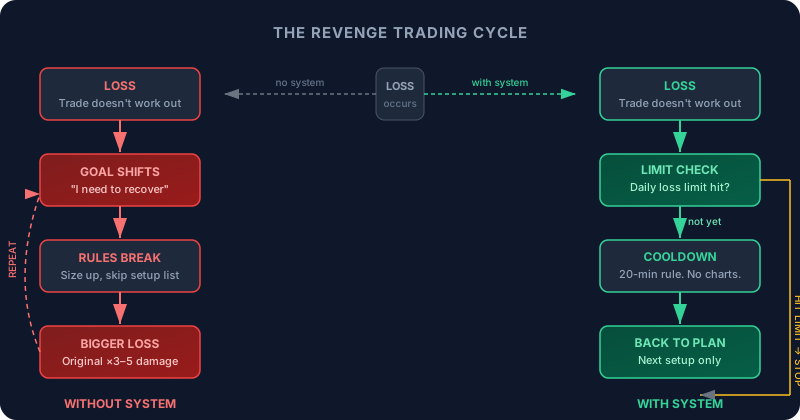
Revenge trading is what happens when your goal shifts from making money to recovering money.
Those two goals look the same from the outside. But they produce completely different decisions:
| Making money goal | Recovering money goal |
|---|---|
| Wait for your A-grade setup | Enter the next thing that moves |
| Stop when daily loss limit hit | "Just one more to get back to flat" |
| Stick to pre-defined position size | Double size to recover faster |
| Exit at plan-defined stop | Widen stop because "it'll come back" |
The moment your goal becomes "I need to recover what I just lost," every discipline rule you've built goes out of the window. And the scary part: you don't notice it happening in real time. You genuinely believe you're making rational decisions.
Why It Hits Indian F&O Traders Harder
Indian F&O markets have specific structural features that amplify revenge trading:
1. High leverage, small capital — Retail traders often trade 1–2 lot NIFTY/BANKNIFTY with ₹50,000–₹1,50,000 capital. One bad trade can wipe 5–10% of capital instantly.
2. The recovery math feels achievable — Lose ₹5,000 at 9:45? You can make that back in one lucky BANKNIFTY trade by 10:30. The possibility of quick recovery keeps you in the game.
3. High volatility windows — The 9:15–10:30 AM and 2:45–3:30 PM windows are volatile. After a loss in the morning, the evening spike looks like the perfect recovery trade. It often isn't.
4. No formal stopping mechanism — Unlike a prop trading desk where a risk manager calls you, retail traders have nobody to tell them to stop.
The 5 Warning Signs You're Already Revenge Trading
Before the framework, it helps to recognise the pattern in your own trade log:
- Trades get clustered after a loss — Look at your trade timestamps. If you took 3 trades in 40 minutes after a losing trade, that's the fingerprint.
- Position size increased mid-session — If your first trade was 1 lot and your fourth trade was 3 lots, ask yourself why.
- You traded outside your setup list — Took a random breakout because it was "obvious" after losing on your regular setup? That's revenge.
- You stopped logging trades mid-session — Traders stop logging when they know subconsciously that they're breaking rules.
- Your loss is a round number — "I'll stop when I'm back to -₹5,000" is a recovery goal, not a trading plan.
Run through your last 30 trade log entries. If you see 3 or more of these patterns, revenge trading is already costing you more than your losing strategy is.
The 5-Step Framework to Make Revenge Trading Structurally Impossible
You cannot rely on willpower. Willpower is exhausted fastest precisely when you've just lost money and your ego is bruised. The goal is to build structural constraints that work even when your emotional brain is fully online.
Step 1: Set a Hard Daily Loss Limit Before You Open the Terminal
The single most effective change you can make.
Pick a number. Something that hurts but doesn't devastate — typically 1–2% of your trading capital. Write it down. If you have ₹1,50,000 in your account, your daily loss limit might be ₹2,500.
The rule: the moment your session P&L hits that number, you are done for the day. No exceptions.
The hard part is not setting the limit — it's enforcing it. This is why tools like SMARTly lock the trade entry form when your loss limit is hit. No willpower required; the form is simply unavailable.
Step 2: Pre-commit to Your Setup List
Before every session, write down — physically or digitally — the two or three setups you are allowed to trade today. Not four. Not "whatever looks good."
If you cannot name the setup and describe the entry criteria in one sentence, you don't trade it.
Example pre-session commit:
Allowed today: Opening Range Breakout above 9:45 candle, VWAP reclaim on pullback. Max trades: 3. Stop trading after 2nd consecutive loss.
When you're staring at a fast-moving BANKNIFTY chart after a loss, having your setup list visible is the difference between discipline and a bad trade.
Step 3: Add a Cooldown Rule After Every Loss
After each losing trade, you sit out for a minimum of 20 minutes. No analysis, no planning the next trade, no watching the chart.
This is uncomfortable. That discomfort is the point. The urge to immediately re-enter after a loss peaks in the first 10–15 minutes. The cooldown rule forces you through that window without acting.
Set a timer on your phone. When it goes off, re-read your setup list and ask: "Is there a genuine setup right now, or am I still trying to recover?"
Step 4: Log Every Trade Immediately — Including the Emotion
The act of logging immediately changes your relationship to each trade. When you have to write "Setup: VWAP reclaim — No, this was a random entry after I felt frustrated," it creates a moment of honest reflection that's hard to avoid.
Log these fields in real time:
- Setup (from your pre-approved list — or "none/impulse")
- Did you follow your rules? (Yes / No)
- Emotional state at entry: Calm / Frustrated / FOMO / Revenge
Over 2–3 weeks of honest logging, the pattern becomes undeniable. Most traders discover that 80% of their losses come from 20% of their trades — and those trades are almost always tagged "Frustrated" or "Revenge."
Step 5: Track Your Discipline Score, Not Your P&L
Daily P&L is a lagging indicator heavily influenced by randomness. Discipline score is a leading indicator you control completely.
At the end of each session, score yourself out of 5:
- Did I follow my setup list? (1 point)
- Did I respect my daily loss limit? (1 point)
- Did I observe the cooldown rule? (1 point)
- Did I log every trade in real time? (1 point)
- Did I stay within my position size plan? (1 point)
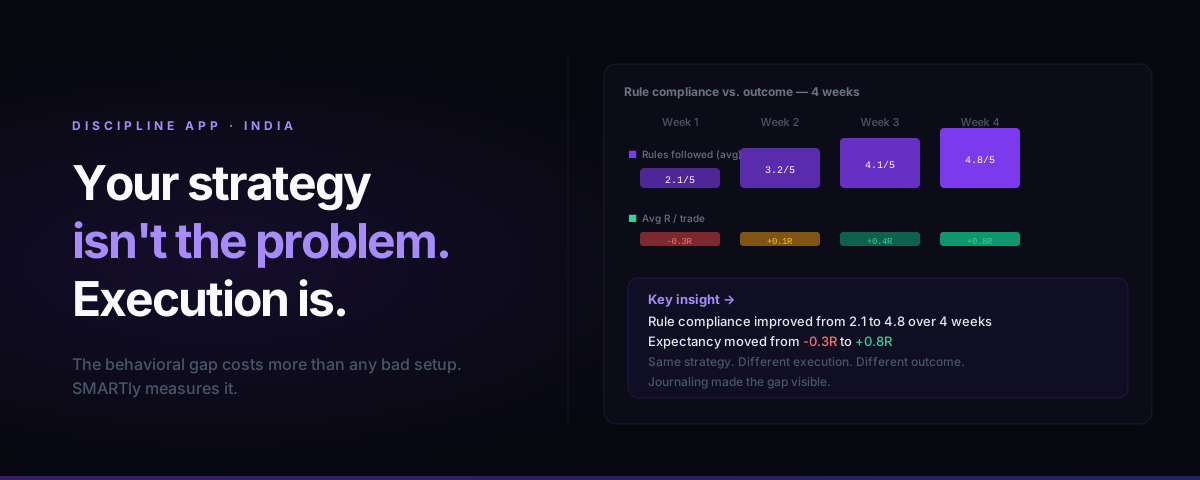
A perfect day is 5/5, even if you lost money. A bad day is 2/5, even if you were profitable.
After tracking this for 30 sessions, the correlation becomes clear: high discipline scores consistently produce better P&L over time. Low discipline scores occasionally produce lucky profits — and reliably produce disasters.
SMARTly calculates this score automatically after each session and shows you a 30-session streak — turning discipline into a measurable metric you can actually get addicted to.
What Changed for Me
After implementing this framework:
| Metric | Before | After 30 sessions |
|---|---|---|
| Average loss days | -₹6,400 | -₹2,100 |
| Trades on loss days | 6.2 avg | 2.8 avg |
| Days with 3+ consecutive trades after loss | 8 of 30 | 1 of 30 |
| Discipline score avg | — | 91/100 |
The average winning days barely changed. The average losing days got dramatically smaller. That's the entire game.
The Honest Part
Revenge trading never fully disappears. You'll still feel the urge to recover a loss — especially after a bad morning. The framework doesn't eliminate the urge. It eliminates your ability to act on it.
That's why structural constraints (loss limit locks, setup pre-commitment, cooldown timers) work where willpower doesn't. When the form is locked, you can feel frustrated all you want. The trade doesn't get placed.
Start with one change this week: set a daily loss limit and enforce it. One rule, consistently applied, will do more for your P&L than any new strategy.
Track your discipline score across sessions, measure win rate by setup, and lock trading when your daily loss limit is hit — free for Indian F&O traders at smartly.works.
Related reading: