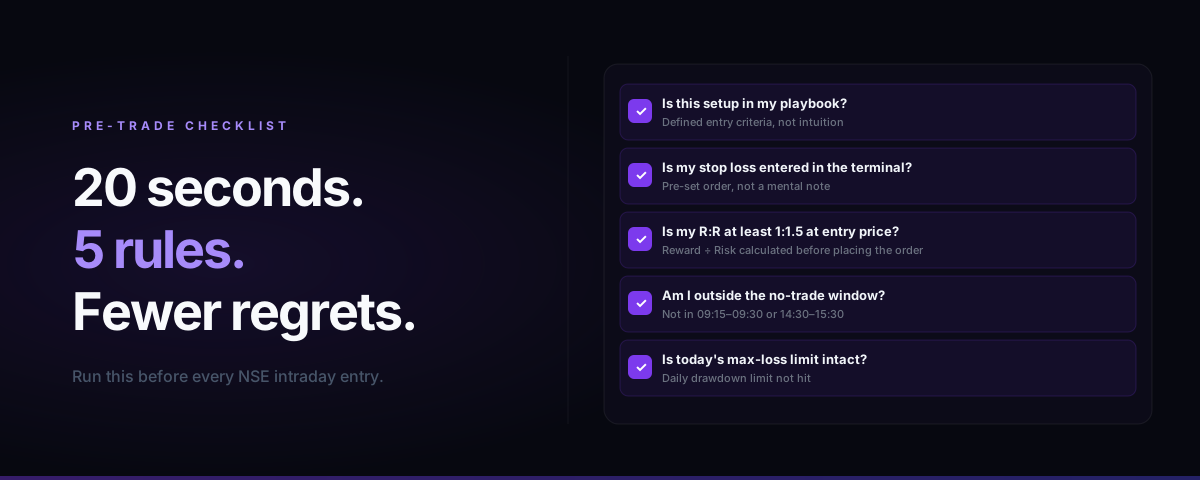
Every trade you regret was a trade where you skipped at least one step in your process.
Not because you didn't know the rule. Because the market was moving and you acted before you checked.
A pre-trade checklist solves this. It takes 20 seconds. And it is, in practice, the single highest-leverage habit a retail intraday trader can build.
Why Checklists Work (and Why Traders Ignore Them)
Aviation and surgery use checklists not because pilots and surgeons don't know the steps — they do. Checklists exist because under pressure, humans skip steps. Always.
Intraday trading is a high-pressure, fast-feedback environment. When a breakout is happening on BankNifty and you're watching price tick through your entry level, your brain is not running a logical sequence. It's pattern-matching and preparing to act.
The checklist is the 20-second circuit breaker between impulse and execution.
Traders ignore them because they feel slow. Until the day a skipped check costs them 3 weeks of gains in one trade.
The 5-Rule NSE Intraday Pre-Trade Checklist
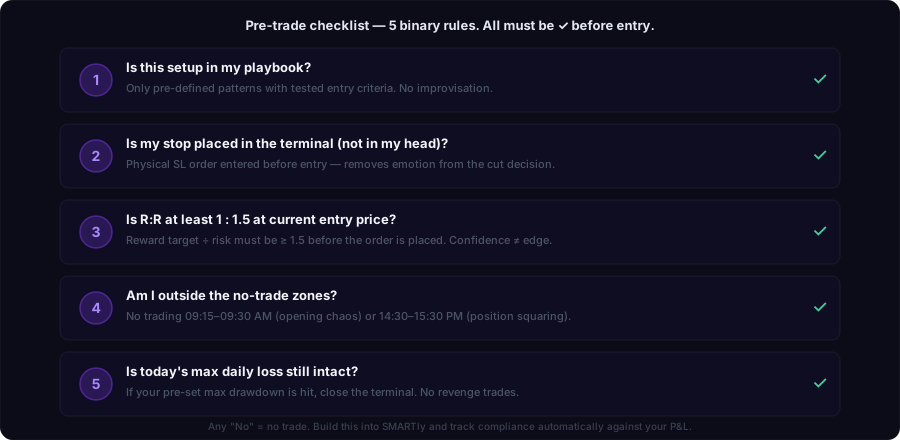
These are binary — yes or no only. If any answer is no, the trade doesn't get placed.
✅ Rule 1: Is this setup in my playbook?
Your playbook is your list of defined, tested setups with specific entry criteria. If the pattern in front of you isn't in your playbook, you are improvising — which means you have no expectation of edge.
What counts as a playbook entry: A setup with a named pattern, specific trigger condition (e.g. "15-minute candle close above opening range high with volume > 1.5x 20-period average"), defined stop placement, and at least 30 historical observations.
Common failure mode: Trading a "looks like an ORB" when it's actually a random consolidation breakout because you're bored.
✅ Rule 2: Is my stop loss pre-defined and entered in the terminal?
Not planned in your head. Not planned in your journal. Placed in Kite, Fyers, or Angel One as a pending SL order before you enter the trade.
This does two things:
- Forces you to think about risk before reward.
- Makes the stop mechanical — removing the decision of when to cut in a losing trade (which is when emotion is highest).
Common failure mode: "I'll set the stop once I'm in." You won't. You'll watch price approach your mental level, convince yourself it'll bounce, and take a 2x loss.
✅ Rule 3: Is my R:R at least 1 : 1.5 at entry price?
Before you enter, calculate:
- Risk (R): Entry price − Stop price × lot size
- Reward target: First target − Entry price × lot size
- Ratio: Reward ÷ Risk
If the ratio is below 1.5, the trade is mathematically unlikely to contribute positively to your expected value over time — unless your win rate is unusually high (above 67%).
Quick NSE example:
- BankNifty CE entry: ₹420, SL: ₹390, Target: ₹480
- Risk: ₹30, Reward: ₹60 → R:R = 1 : 2 ✅
Common failure mode: Taking 1:1 trades because "I'm confident this one will work." Confidence is not edge. Math is edge.
✅ Rule 4: Am I outside the no-trade zones?
NSE intraday has two periods where retail traders consistently lose money and should not trade:
09:15 – 09:30 AM — The opening 15 minutes have extreme spread, fake breakouts, and institutional order flow that overwhelms retail signal. Most "ORB" setups need the range to be established first.
14:30 – 15:30 PM — The last hour is dominated by position squaring, especially in F&O. Moves are often sharp but mean-reverting and unpredictable.
Refine your own no-trade zones by running your journal by 30-minute time blocks. Your red zones may differ.
Common failure mode: "This setup is so strong I'll take it at 09:18." It isn't. You're seeing what you want to see.
✅ Rule 5: Is today's max-loss intact?
Set a daily max-loss number before the week starts — not in the moment. A common rule: 2% of trading capital, or 3× your average winning trade.
If hitting this number would end your trading day, it means you've already had a bad day. Adding more trades on a bad day is statistically proven to make it worse — not better.
Common failure mode: "I'll make back the morning loss in the afternoon session." This is the thought that turns a 1% loss into a 4% loss.
How to Use This Checklist
Option A — on paper: Print this list and put it beside your monitor. Run through it out loud before every entry. Literally say the answers.
Option B — in a trade journal: Add a rules followed (n/5) column to your journal. Force yourself to score every trade. Review the distribution every Sunday — your loss trades will cluster at low scores.
Option C — in SMARTly: Build your 5-rule checklist in the platform. Each trade prompts you to confirm the checklist before logging. Rule compliance is tracked automatically against your P&L. Try it free →
Building Your Own Checklist
The five rules above are a validated starting point, not a permanent prescription. After 30–50 trades, review your data and adjust:
- Is one rule never broken? It might be too easy — tighten it.
- Is one rule always broken? It might be wrong for your style — replace it.
- Are your best trades (highest R) consistently 5/5? Then the checklist is working.
The goal is a checklist where hitting 5/5 meaningfully predicts better outcomes. If it doesn't, the rules aren't specific enough.
Track your checklist compliance automatically with SMARTly — start free, no credit card required.
Related reading: