Most retail traders who lose consistently don't have a strategy problem. They have a pattern-repetition problem — they take the same bad trades, in the same emotional state, at the same time of day, and wonder why February looks exactly like January.
A trade journal is the fix. But only if it captures the right data. Most journaling formats fail because they ask too much, get abandoned after three days, and never get reviewed.
This guide gives you a minimal, usable intraday trading journal template for NSE/BSE traders — and a weekly review process you can do in 15 minutes.
Why Most Intraday Trading Journals Don't Work
Before the template, understand why traders stop journaling:
- Too many fields — 30-column spreadsheets get abandoned fast.
- No review ritual — Data that's never reviewed changes nothing.
- Recording P&L instead of behaviour — Rupee profit per trade tells you nothing about why you won or lost.
The goal of your intraday journal is not to record history. It is to find the one rule you're breaking most and fix it.
The 5 Fields That Actually Matter
Strip your journal to these five columns and you have everything you need for a meaningful weekly review:
- Setup name — What triggered the entry? (Opening Range Breakout, VWAP reclaim, supply/demand rejection, etc.)
- Entry time and price — Timing patterns emerge quickly. Do you always lose trades entered after 2:00 PM?
- Pre-defined stop loss — Was it defined before entry, or improvised after price moved against you?
- R:R at entry — Did the trade deserve to exist? Minimum 1:1.5 is a reasonable baseline.
- Rules followed (score) — How many of your five pre-trade rules did you actually follow? Track this as
3/5,5/5, etc.
Skip these: lengthy emotion diaries, "what I learned" essays written immediately after a trade, and P&L in rupees. Use R multiples instead — they normalise for position size and make patterns visible.
The SMART Intraday Trading Journal Template
Copy this format into a spreadsheet, Notion table, or use SMARTly which auto-fills most columns from your broker data.
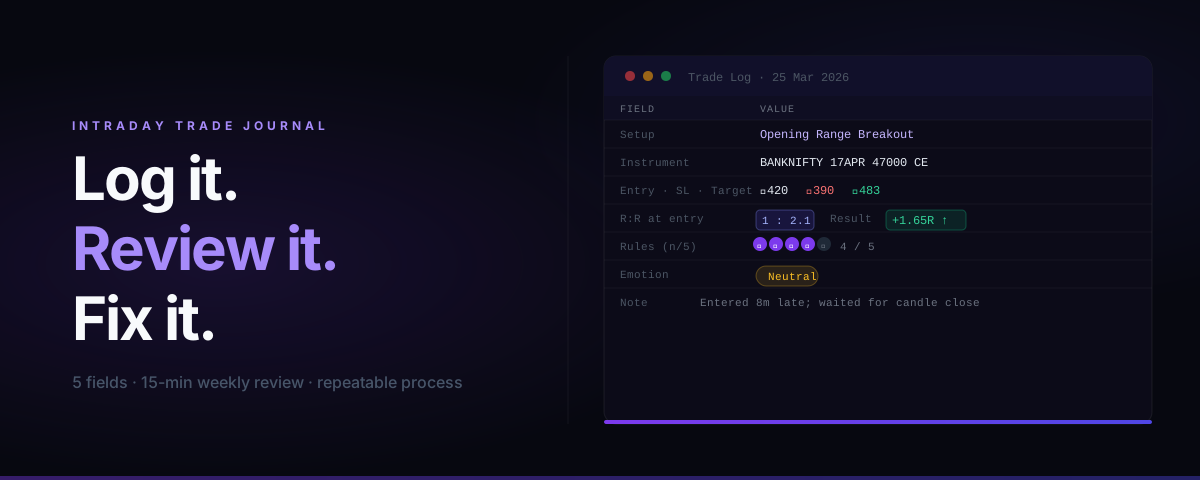
| Field | Example | Why It Matters |
|---|---|---|
| Date | 25 Mar 2026 | Weekly grouping |
| Instrument | BANKNIFTY 17APR 47000 CE | Exact reference |
| Setup | Opening Range Breakout | Pattern recognition |
| Direction | Long | — |
| Entry time | 09:32 AM | Reveals timing patterns |
| Entry price | ₹420 | — |
| Stop loss | ₹390 (pre-defined) | Discipline audit |
| Target | ₹483 | R:R baseline |
| Exit time | 10:15 AM | — |
| Exit price | ₹385 | — |
| R:R at entry | 1 : 2.1 | Was the trade worth taking? |
| Actual R multiple | −0.83R | How did execution compare? |
| Rules followed | 3 / 5 | Discipline score |
| Emotion tag | FOMO | Pattern trigger |
| One-line note | Missed first entry, chased 8 min later | Key learning |
Your 5-Rule Pre-Trade Checklist
This is separate from the journal — it runs before you enter. If you can't tick all five, the trade doesn't get made.
Personalise the five rules for your own system. A common starting point for NSE intraday traders:
- Is this setup in my verified playbook?
- Is my stop loss pre-defined and entered in the terminal?
- Is my R:R at least 1 : 1.5?
- Am I in the no-trade zone (09:15–09:30 AM or after 14:30)?
- Have I already hit today's max-loss limit?
The binary nature of this checklist is intentional. "Mostly yes" is a no.
The 15-Minute Weekly Review Process
The journal only works if you review it. Here is a repeatable Sunday process:
Step 1 — Sort by emotion tag (5 minutes)
Group your trades by tag: FOMO, revenge, bored, neutral. Which tag had the worst average R multiple? That emotion is costing you money right now.
Step 2 — Find your worst rule (5 minutes)
Count rule-following scores across the week. Which rule did you break most? Not your P&L — your rule compliance. The two are usually correlated, but the rule is actionable.
Step 3 — One tweak only (5 minutes)
Pick a single change for next week:
- A tighter trigger condition for one setup
- A hard time-ban you're not currently respecting
- Removing a rule that doesn't suit your trading style
One change. Not three. One.
From Spreadsheet to Automated Journal
Manually filling in entry/exit time, price, P&L, and R multiples works — until you have 30–40 trades a week across multiple accounts. The admin overhead starts to erode the discipline benefit.
SMARTly auto-imports your trades directly from Zerodha, Fyers, Angel One, and other supported Indian brokers. It maps each trade to your playbook, computes R multiples automatically, tracks your rule compliance per trade, and generates the weekly breakdown without you touching a spreadsheet.
SMARTly is a trade journal and performance tracker built specifically for serious Indian retail traders. No ads, no data selling — your data stays in your own Supabase instance.
Related reading: