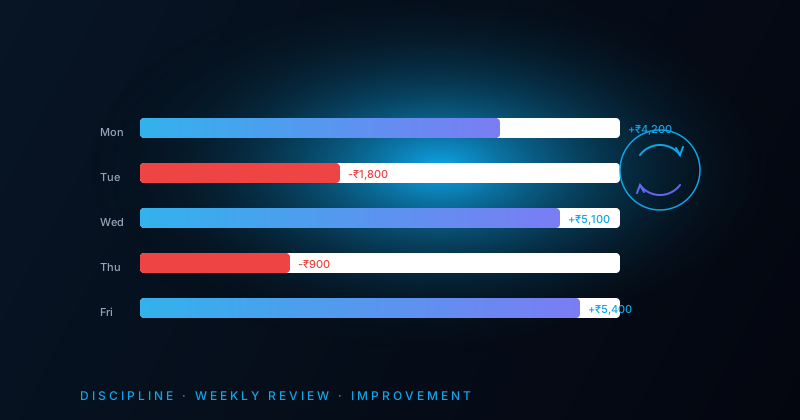
Most traders review their trades when they're losing. They scan the journal, feel bad, and close the tab. This is the least effective way to learn from your trading data.
A weekly review, done consistently with a clear structure, is how traders actually improve. Not by finding a new indicator. Not by reading more books. By systematically extracting patterns from their own behaviour and changing one thing at a time.
This is the process. It takes about 45 minutes. Do it every Saturday morning.
Part 1: The Numbers (10 minutes)
Open your analytics for the past week and record these seven numbers:
- Total trades taken
- Total P&L (net after brokerage)
- Win rate (% of winning trades)
- Average winner vs average loser (in rupees)
- On-plan % (what % of your trades followed your pre-defined rules)
- Discipline score (if you use a journaling tool that calculates one)
- Best trade and worst trade of the week
Write these down. Don't just look at them — write them. The act of writing forces you to actually register the numbers rather than scroll past them.
These numbers are your weekly baseline. You are not trying to judge them as good or bad yet. You are just recording them.
Part 2: Pattern Search (15 minutes)
Now look for patterns. Go through each losing trade and answer:
A. What type of mistake was this?
Group your losses into categories:
- FOMO / chasing — entered after the move was already extended
- Overtrading — exceeded your trade count limit
- Revenge — traded to recover a loss without a valid setup
- No stop — held a losing position hoping it would recover
- Impulse — entered without a clear setup
- Correct setup, bad outcome — valid trade that just didn't work
This classification matters. The last category (correct setup, bad outcome) is not a mistake — it's variance. The first five categories are behavioural mistakes that compound over time if unaddressed.
B. What was your most expensive mistake category this week?
If FOMO trades cost you ₹4,500 and revenge trades cost ₹1,200, your focus for next week is FOMO.
C. Did any winning-trade pattern repeat?
Look at your winners. Is there a setup that appeared multiple times? A specific time of day when your win rate was higher? A particular market condition where you traded well?
Most traders spend 90% of their review on losses. The winners are equally important — they tells you where your edge actually is.
Part 3: The One Change (10 minutes)
Based on what you found in Part 2, define one specific change for next week.
Not five changes. One.
Examples of good changes:
- "Next week I will not trade in the first 15 minutes of the session."
- "Next week if I have two losses I stop for the day."
- "Next week I will only trade the Opening Range Breakout setup."
- "Next week I will log a mandatory reason before entry."
Examples of bad changes (too vague):
- "I will trade more carefully."
- "I will be more disciplined."
- "I will trust my analysis."
A usable change is one that you can check at the end of next week. "Did I trade in the first 15 minutes?" is a yes/no question. "Did I trade more carefully?" is not.
Write this change down in your journal. At next week's review, the first thing you check is whether you followed this single rule.
Part 4: Mental Reset (10 minutes)
This part is often skipped. Don't skip it.
4a. Write down one trade you're proud of this week. Not necessarily a winner — it can be a trade where you followed your rules perfectly, even if it lost money. Or a trade where you correctly sat on your hands and avoided a FOMO entry.
Reinforcing good behaviour is as important as correcting bad behaviour. Your brain needs to know what "right" looks like.
4b. Write down one thing you're carrying into next week that you want to let go of.
This might be frustration about a losing week. Overconfidence from a good one. A narrative ("BNF is always bullish on Tuesdays") that isn't backed by data. Grudges against a particular setup or stock.
You cannot review the past week clearly if you're carrying emotional residue from it. The act of naming what you're holding, and consciously deciding to set it down, is not psychology fluff — it's cognitive hygiene.
The Review Template
Here's a simple format you can copy into Notion, a physical notebook, or SMARTly's journal:
WEEKLY REVIEW — [Date range]

Numbers:
Trades: ___ | P&L: ₹___ | Win rate: ___% | On-plan: ___%
Avg winner: ₹___ | Avg loser: ₹___

Most expensive mistake: _______________
Most profitable pattern: _______________

One change for next week:
→ _______________

Trade I'm proud of: _______________

One thing I'm letting go of: _______________
How Often Should You Expect to See Improvement?
Expect nothing for the first four weeks. You're building the habit. The first month of data is mostly noise — too few trades, inconsistent logging.
By week 8–10, you'll start seeing meaningful signal: a mistake category that keeps repeating, a setup that keeps working, a time-of-day that consistently hurts you.
By month 6, traders who review consistently typically see measurable improvement in their discipline score, on-plan percentage, and average loss per trade. P&L improvement follows those leading indicators.
The review is not a shortcut to profit. It's the mechanism by which you close the gap between what you know you should do and what you actually do.
Every professional trader reviews their performance. Not because it's enjoyable — reviewing losses never is — but because without systematic reflection, experience doesn't automatically translate into improvement. You can make the same mistake for five years and call it "experience."
Forty-five minutes on Saturday changes that.
Related reading: