If you've been trading for more than three months and your account is smaller than when you started, this post is for you.
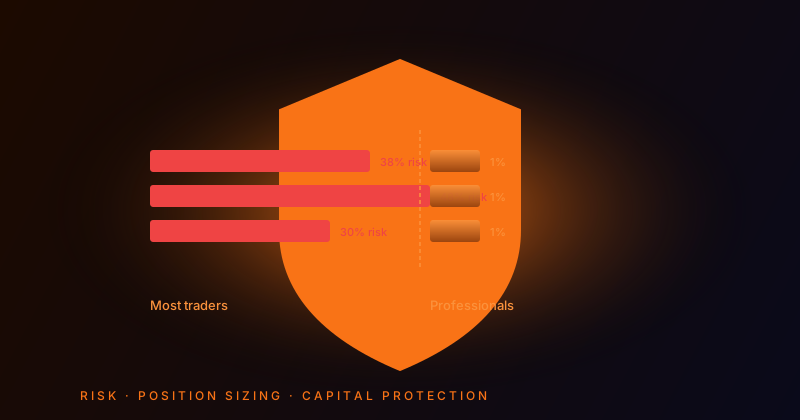
The most common reason Indian retail traders lose money isn't bad setups, bad timing, or bad luck. It's bad position sizing.
The Problem: You're Risking Too Much Per Trade
Most new traders size positions based on one of two things:
- The money they "feel comfortable" putting in
- Round lot sizes (1 lot of Nifty, 1 lot of BankNifty)
Neither of these has anything to do with how much you should actually risk.
Here's the consequence. If you trade 1 lot of BankNifty options and buy a ₹100 premium contract with a lot size of 15, you've spent ₹1,500. But if your account is ₹50,000, that's 3% of your account in a single trade. On a bad week with 4 losses, you've lost 12% before you've even realised there's a problem.
The 1% Rule — Start Here
The 1% rule is simple: never risk more than 1% of your trading capital on a single trade.
If your trading capital is ₹1,00,000:
- Maximum loss per trade = ₹1,000
- If your stop-loss on a Nifty CE is ₹20 per lot, and lot size is 50: total risk = ₹20 × 50 = ₹1,000 ✅
- If you want to take 2 lots, your stop needs to be ₹10 per unit
The 1% rule doesn't mean bet ₹1,000 on every trade. It means define your stop-loss first, then calculate how many lots you can take so that if you hit the stop, you lose only 1%.
How to Calculate Position Size — Step by Step
Step 1: Define your risk per trade
Capital: ₹2,00,000
Risk per trade (1%): ₹2,000
Step 2: Define your stop-loss in rupees
You're buying Nifty 22500 CE at ₹150
Your stop-loss: ₹120 (₹30 risk per unit)
Lot size: 50
Risk per lot: ₹30 × 50 = ₹1,500
Step 3: Calculate lots
Max lots = ₹2,000 / ₹1,500 = 1.33 → take 1 lot
This is the correct way to size. You don't ask "how much can I afford?" — you ask "how much do I want to lose if I'm wrong?"
Why 1%? Why Not 5%?
A 5% risk per trade sounds manageable. But consider the math:
| Risk per trade | Consecutive losses to lose 20% of capital |
|---|---|
| 1% | 22 losses |
| 2% | 11 losses |
| 5% | 4 losses |
| 10% | 2 losses |
Four bad trades in a row is not unusual. It happens to every trader. At 5% risk, those four losses wipe out 20% of your account, which requires a 25% gain just to break even.
With 1% risk, four losses cost you 4%. You recover easily.
The Practical Challenge for F&O Traders
The problem with options is that lot sizes are fixed. You can't take 0.5 lots.
The solution is to adjust your strike selection based on the premium, not the other way around.
If your maximum risk is ₹800 per trade (0.8% of ₹1,00,000) and lot size is 50:
- Maximum premium risk per unit = ₹800 / 50 = ₹16
If you're planning a stop-loss at 50% of the premium, you need to buy options at ₹32 or less. This might mean going slightly deeper OTM than usual — but that's the discipline of proper sizing.
Common Objections
"But I'll miss bigger moves if I go OTM"
You'll also lose less when you're wrong, which is far more often than you think when you're starting out.
"My account is too small to use 1% risk"
If your account is ₹25,000, 1% is ₹250 per trade. That's actually realistic in options if you're selective. If it's genuinely too small, the answer is to grow your account first through paper trading, not to increase risk.
"Professional traders risk more"
Professional traders also have 5-10 years of data on their own edge. They know their win rate, average win/loss ratio, and maximum drawdown. Until you have that data, stay conservative.
What's a Good Loss Limit Per Day?
Beyond per-trade risk, set a daily loss limit. A common rule: stop trading when daily losses exceed 3% of capital. This prevents the "trying to recover" spiral that turns bad days into catastrophic days.
If your capital is ₹1,00,000 and you hit ₹3,000 in losses by 11 AM — close the screens. Log the trades. Study what went wrong. Return tomorrow.
How SMARTly Helps You Track This
SMARTly lets you set a daily maximum loss limit when you start your session. When you approach it, you see a visual warning. When you hit it, the session caps itself.
More importantly, after 20-30 trades you can see your average loss per trade in the analytics view. If your planned risk was ₹1,000 but your actual average loss is ₹2,400 — that gap tells you exactly where the discipline is breaking down.
Position sizing is not glamorous. It doesn't appear in trading books as prominently as chart patterns or indicators. But it's the single most powerful thing a new trader can do to survive long enough to actually get good.
Start with 1%. Review after 30 trades. Adjust upward only once you have a proven edge.
Related reading: