If you've been trading intraday on NSE for more than six months, you've probably noticed a frustrating pattern: you know what to do, but you don't consistently do it.
You have a setup. You have rules. And yet, the month ends with the same trades you promised yourself you'd stop taking — the revenge trade after a stop-out, the oversized position when you felt "sure", the exit two minutes early because you got nervous.
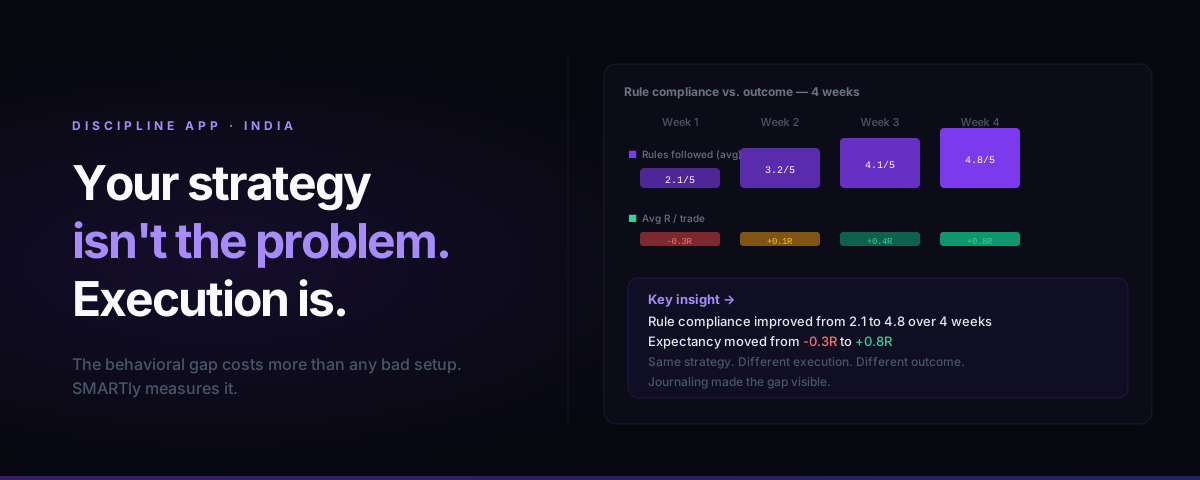
This isn't a strategy problem. It's a behavioral execution gap — and almost no trading tool in India is built to address it.
What Most Intraday Trading Apps Get Wrong
The Indian trading app ecosystem is dominated by two things:
- Broker terminals (Kite, Fyers Web, Angel One) — excellent for execution, zero for reflection.
- Strategy screeners and scanners — great for finding setups, useless for understanding why you didn't follow them.
Neither category helps you answer the only question that matters for a trader who already has a system:
Which specific rule did I break most this month, and what did it cost me?
Answering that question requires a journal. Not a spreadsheet — a structured trade journal with playbook mapping, rule scoring, and R-multiple tracking.
What SMARTly Is
SMARTly is a trade journal and behavioral discipline workspace built specifically for serious Indian intraday traders.
Here's what it does that a spreadsheet can't:
Auto-import from Indian brokers — Connect Zerodha, Fyers, Angel One, Dhan, ICICI Direct, or Upstox. SMARTly reads your trade history and fills in entry price, exit price, time, instrument, and P&L automatically. You log once, you review forever.
Playbook-based tagging — Define your setups (Opening Range Breakout, VWAP reclaim, gap-and-go, supply/demand). Every trade gets tagged to a setup. After 30 trades, you see which setups actually have edge in your hands — not in backtests.
Rule compliance scoring — Build a 5-question pre-trade checklist. Each trade gets a compliance score (3/5, 5/5). The weekly view shows whether your win rate correlates with rule-following. It almost always does.
R-multiple tracking — P&L in rupees is noisy. R multiples are not. SMARTly converts every trade to an R multiple based on your pre-defined stop, so you can compare a ₹2,000 win on 1 lot against a ₹5,000 win on 4 lots correctly.
Session and drawdown controls — Set a daily max-loss. SMARTly blocks new trade logging once you've hit it and asks you to end the session. The nudge is gentle — but it's there every single day.
Who It's For
SMARTly is built for retail traders who:
- Already have a defined setup or system, but struggle with consistent execution
- Trade intraday on NSE/BSE — equities, F&O, or both
- Import trades from Zerodha, Fyers, Angel One or another supported Indian broker
- Are serious enough to journal, but want the admin overhead handled automatically
If you're still searching for a strategy, SMARTly isn't the right tool yet. Come back when you have rules to track.
What This Blog Is
Every post here is a short, practical lesson — a rule, a checklist, a journal template, or a concept — that you can apply the next trading day.
No paid course upsells. No "my trade made ₹1 lakh today" screenshots. Just the process work that separates consistent traders from everyone else.
Start with the intraday trading journal template — it's the single most useful thing we've published.
TL;DR
Welcome to SMARTly. This blog is dedicated to helping intraday traders replace guesswork with repeatable rules, simple journal workflows, and measurable improvements. Read one short lesson, try one checklist item the next trading day, and log the result.
Why SMARTly exists
Most traders lose consistency because their process is fuzzy: unclear entries, inconsistent sizing, and emotional exits. SMARTly focuses on small, testable changes — a rule, a checklist, and a journal entry — so you can measure what works and iterate.
What you'll find here
- Rules-first trade set-ups with clear entry and exit criteria.
- Trade-journal templates (CSV / copyable tables) so you can log decisions and outcomes.
- Short post-trade reviews showing what to measure and how to spot behavioural leaks.
- Risk-sizing and position-sizing rules that protect capital.
First checklist (use tomorrow)
- Pre-market: list two setups you will trade and a maximum loss for the day (₹).
- Size positions per rule: risk no more than X% of starting capital per trade (choose your X).
- Enter only when your checklist is satisfied (price + volume + confirmation candle).
- Record each trade in your journal immediately after execution (symbol, side, size, entry, stop, exit, reason).
- End-of-day: one short review — what worked, what didn’t, and one improvement for the next day.
How to use SMARTly
- Subscribe for weekly lessons and templates.
- Start with the journal template in the first post you apply to your trades.
- Track one metric for a month (win rate, avg P/L, or risk per trade) and iterate.
Get involved
Have a question or want to suggest a topic? Email hello@smartly.works. Interested in contributing a post or a case study? Reply to the same address.
Thanks for reading — trade with rules, not emotion.
— SMARTly
Related reading: